


- 0 Comments
- By sunflameadmin
- Latest News
- 36 Likes
Modern industries always need pieces that feel solid, dependable, and priced in a way that makes sense. For instance, an automotive engine block, a pump housing, agricultural equipment, or even heavy engineering machinery often rely on parts made using sand casting. And it’s still one of the most used metal casting techniques, not just because it’s capable, but because it blends flexibility, durability, and economical output into something practical.
Unlike a lot of other casting approaches, sand casting can handle both smaller precision components and bigger industrial elements across a broad set of metals. Even as production keeps changing, sand casting stays a key step for industries that want dependable cast items and still don’t want to compromise on quality.
If you’re new to this manufacturing process, you might start by checking our guide on What Is Sand Casting and the Sand Casting Process, so you get the idea of how it works before jumping into the real world uses.
Why Sand Casting Is Used Across Multiple Industries
One of the main reasons manufacturers keep choosing sand casting is its real flexibility. The method lets foundries create parts with many different sizes, forms, and geometry levels while still keeping a strong mechanical performance.
So whether a manufacturer is after a small valve body, or a heavy machinery housing that can weigh several hundred kilograms, sand casting can support that kind of range. It’s also a compatible option for iron, steel, and various alloy grades, which makes it useful for different industrial needs without forcing constant redesign.
That ability is why products made from sand casting have become kind of an essential piece of modern manufacturing systems.
Common Products Made from Sand Casting
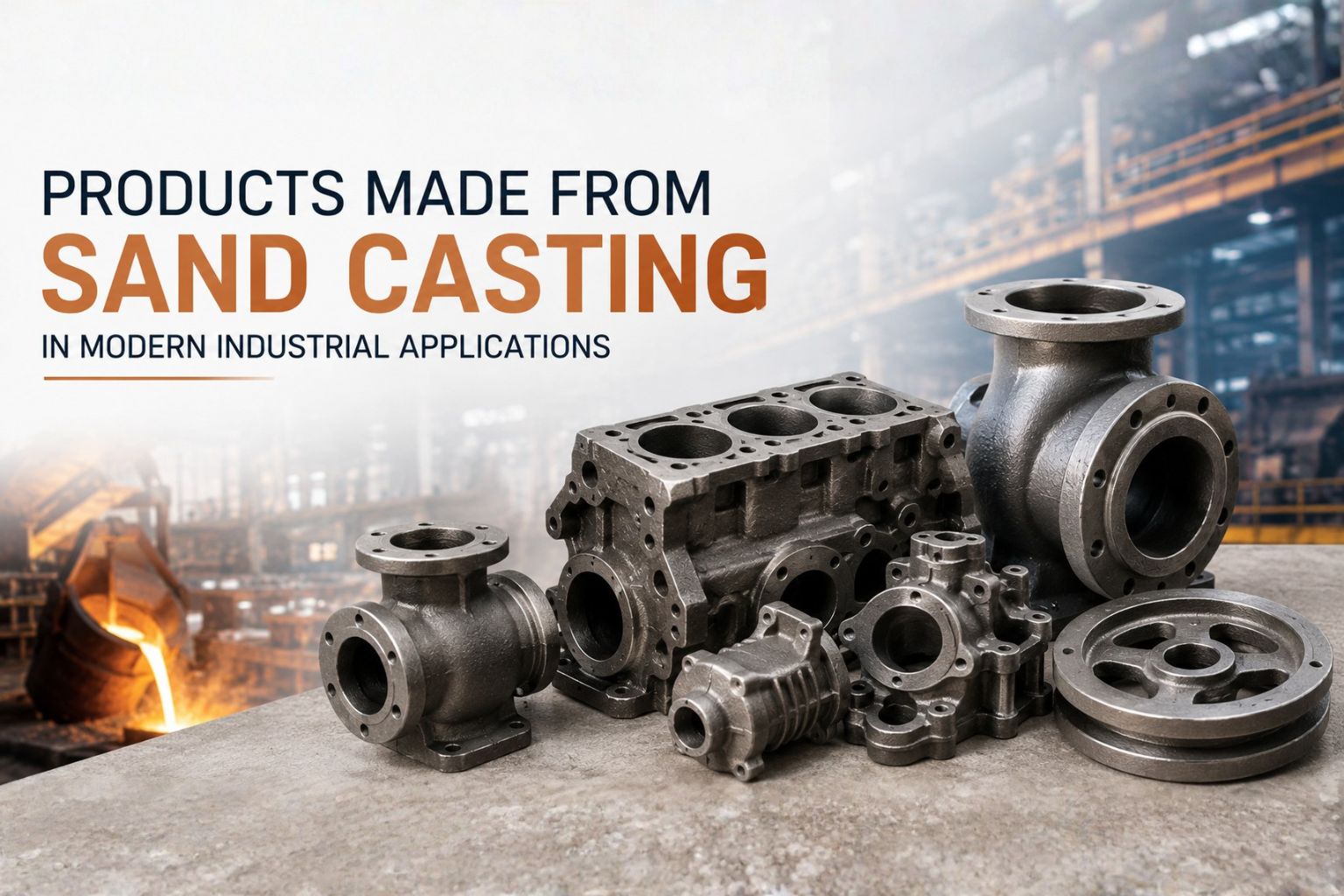
The applications of sand casting extend across almost every major industrial sector. Below are some of the most common products manufactured using this process.
Automotive Components
The automotive industry depends heavily on sand casting because many critical vehicle parts require high strength and dimensional accuracy. Manufacturers produce engine blocks, brake drums, transmission housings, differential cases, and flywheels through sand casting due to its ability to create complex internal structures.
To learn more, read our article on Sand Casting for Automobile Components.
Some common automotive castings include:
- Engine blocks
- Brake drums
- Flywheels
- Transmission housings
- Differential casings
Pump and Valve Components
Industrial pumps and valves work under high stress conditions where endurance and accuracy are really important. Sand casting lets manufacturers form parts with intricate internal flow paths, while still keeping the basic structure strong.
Common products include:
- Valve bodies
- Pump casings
- Impellers
- Pipe fittings
- Flanges
These parts are used a lot in water purification facilities, chemical processing operations , oil and gas environments , and in power generating systems.
Agricultural Machinery Components
Agricultural machines run nonstop in difficult outdoor settings so durable cast components matter for dependable output.
Sand casting is a major piece in making tractor frames, gearbox housings, irrigation sections, and also harvesting tools. These castings bring the resistance required to handle heavy loads and rough field conditions.
For more insights, explore Top Agricultural Casting Manufacturer for Tractors and Harvesters.
General Engineering Components
General engineering sectors also lean on sand casting for machinery parts, load bearing assemblies , and industrial equipment in general.
Typical products include:
- Machine bases
- Bearing housings
- Gear casings
- Compressor bodies
- Industrial brackets
You can also read Sand Casting for General Engineering Components: Precision and Reliability for Manufacturers to understand these applications in greater detail.
Why Manufacturers Prefer Products Made from Sand Casting
Beyond that, sand casting has a few hands-on advantages that make it a go to manufacturing approach for industrial uses.
Producers pick components made this way because they can reach steady quality levels while still controlling production expenses. The technique is especially helpful for medium to larger production runs, where toughness and design flexibility are both needed.
Key benefits include:
- Cost-effective tooling
- Suitable for complex geometries
- Excellent mechanical strength
- Wide material compatibility
- Scalable production
- Easy customization
All these reasons help explain why sand casting stays one of the more dependable fabrication methods worldwide.
Quality Control Plays an Important Role
Making top tier castings takes more than a smooth casting operation. Each component has to go through strict checks , so it actually satisfies dimensional, mechanical, and metallurgical requirements.
Modern foundries do a bunch of checks like chemical analysis, mechanical testing, dimensional inspection and also non-destructive testing (NDT) before anything ships to customers. That kind of quality assurance procedure helps cut down on defects and, at the same time, keeps long‑term product dependability more or less intact.
To learn more about inspection methods, read Testing Facility at Sunflame Technocast for Quality.
Sand Casting Continues to Support Modern Manufacturing
Even with newer manufacturing technologies showing up all the time, sand casting is still counted among the most dependable ways to produce parts. It can manufacture everything from small precision pieces to large scale industrial castings, so it ends up working across industries, automotive and agriculture included, plus heavy engineering and infrastructure too.
For jobs where people want tighter limits and smoother surface results, manufacturers often weigh sand casting against shell mould casting, since the comparison can be pretty practical in the field. You can explore the differences in Why Shell Mould Casting Is Ideal for Precision Industrial Components.
Conclusion
The broad range of products produced by sand casting is basically why the process keeps mattering in today’s industry. From automotive parts and pump housings, to agricultural machinery and heavy duty equipment, sand casting offers robustness, long service life, and flexibility that industrial users look for.
And as manufacturers keep searching for methods that are both reliable and cost-friendly, sand casting remains one of the most trusted options for making high quality industrial components that keep performing consistently in tough conditions.s castings, shell mould casting is still among the most trusted and practical casting processes out there, today.
Contact Us for more information:
📞 +91 99248 11655
📧 info@sunflametechnocast.com

