


- 0 Comments
- By sunflameadmin
- Latest News
- 39 Likes
Honestly nowadays, a lot of modern manufacturers keep leaning on sand casting because it lands in that kind of sweet spot between affordability, long term durability, and production flexibility. It really does sorta add up once you look at it, the material is pretty standard, the process is well proven, and the finished parts are generally dependable.
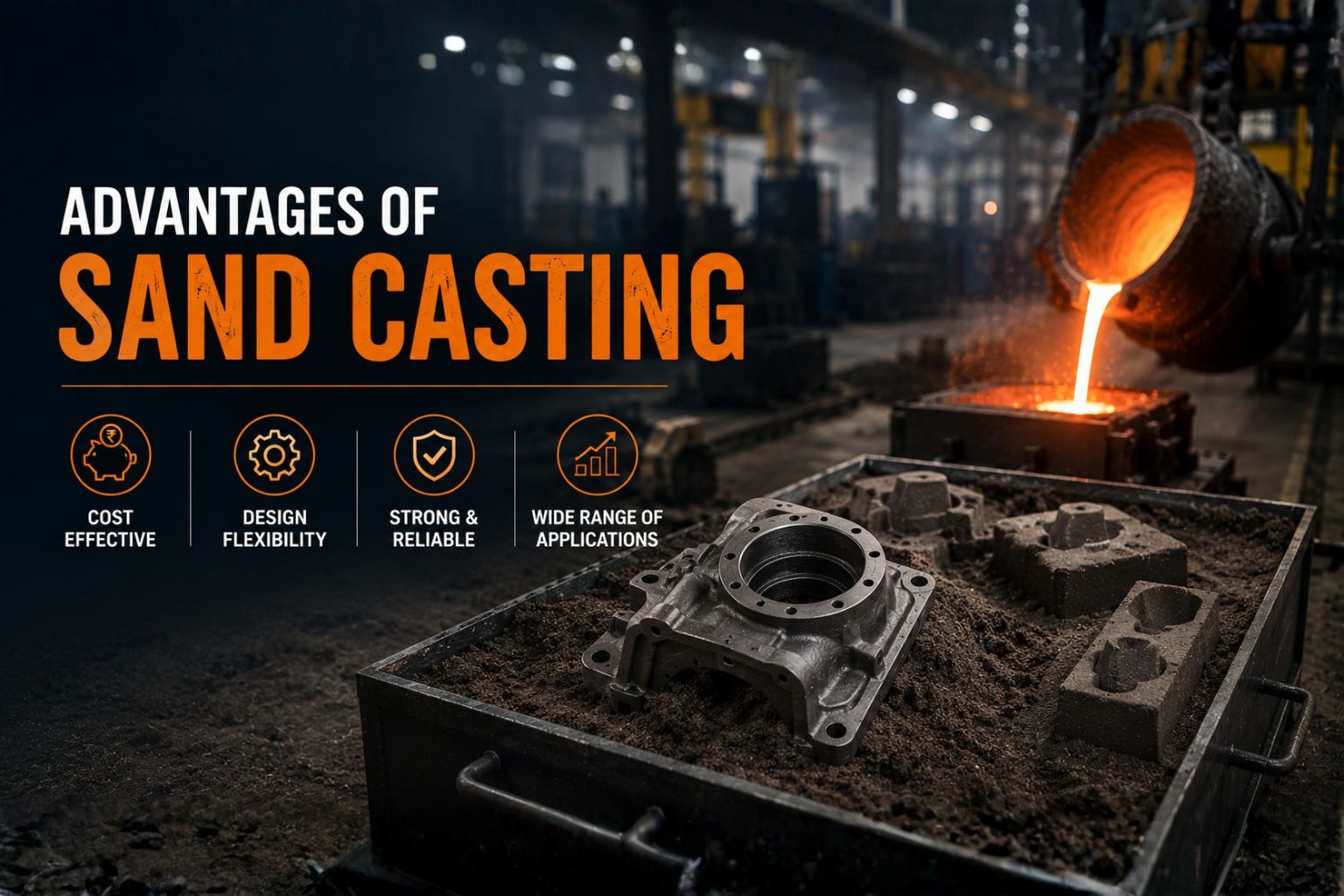
Some of the biggest advantages of sand casting include:
- Cost-effective production for medium and large batches
- Lower tooling costs compared to many casting methods
- Ability to produce both small and large components
- Excellent design flexibility for complex geometries
- Compatibility with a wide range of metals and alloys
- Reliable mechanical strength for industrial applications
Why Sand Casting Still Matters in Modern Manufacturing
Manufacturing is even more competitive these days. Raw material costs keep moving upward, production budgets feel tighter, and clients expect higher performance every month, so makers end up choosing processes that offer value as well as quality.
That is exactly why the advantages of sand casting keep showing up as one of the most trusted manufacturing processes worldwide. From automotive and agriculture, to heavy engineering and infrastructure, sand casting helps companies produce durable industrial parts while also keeping the production costs under control.
Also, unlike certain highly specialized casting approaches that need pricey tooling or bring annoying size limits, sand casting offers a lot of flexibility. It can be adjusted for many different industrial uses, depending on what the project needs.
If you’re new to this approach, start with our guide on What Is Sand Casting and the Sand Casting Process. It lays out how the process works in detail, before you jump into the advantages.
Top Advantages of Sand Casting
1. Cost Efficiency Without Compromising Quality
One of the biggest benefits of sand casting is that it can create high quality components while avoiding heavy tooling investment.
For manufacturers handling medium to large production runs, this often translates into lower overall manufacturing costs and a better return on investment.
Why It Helps Lower Manufacturing Costs
Sand casting minimizes production expenses because it requires relatively simple tooling and flexible mold preparation.
Some key cost benefits include:
- Lower tooling investment
- Economical pattern production
- Affordable prototype manufacturing
- Reduced setup costs
- Scalable production volumes
Better Value for Industrial Manufacturers
Since tooling cost are usually relatively low, manufacturers can react faster to design revisions or customer specific requirements without getting hit with major extra expense.
That’s why sand casting is especially appealing for OEMs and those producing custom components.
2. Excellent Design Flexibility for Complex Components
Industrial products continue to become more advanced, requiring castings with internal cavities, intricate shapes, and detailed geometries.
This is where sand casting offers a significant advantage.
Unlike many manufacturing methods, sand casting can produce highly complex components in a single casting process, reducing the need for multiple fabricated parts.
Typical examples include:
- Pump casings
- Valve bodies
- Engine blocks
- Machine bases
- Gear housings
For components requiring even tighter tolerances and smoother finishes, you can also explore our article on Why Shell Mould Casting Is Ideal for Precision Industrial Components.
3. Suitable for a Wide Range of Industries
One reason sand casting has remained relevant for decades is its versatility across multiple industrial sectors.
Rather than serving a single market, it supports industries with very different manufacturing requirements.
| Industry | Common Sand Cast Products |
| Automotive | Engine blocks, brake drums, transmission housings |
| Agriculture | Tractor parts, gearbox casings, irrigation components |
| Pumps & Valves | Valve bodies, impellers, pump housings |
| Heavy Engineering | Machine bases, structural castings |
| Construction | Equipment housings, industrial brackets |
The automotive industry, in particular, depends heavily on this manufacturing process. Learn more in our blog on Sand Casting for Automobile Components.
Similarly, agricultural equipment manufacturers rely on durable castings for tractors and harvesters. Explore this further in Top Agricultural Casting Manufacturer for Tractors and Harvesters.
4. Reliable Performance for Modern Industrial Applications
Still, saving money alone isn’t enough. Industrial components need long term dependability too, especially in harsh working environments.
This is another area where the advantages of sand casting become clear.
Strong Mechanical Properties
Sand cast components are widely used because they offer:
- Excellent structural strength
- Good wear resistance
- High load-bearing capability
- Long service life
Those mechanical behaviors are a big reason sand cast parts fit heavy duty industrial uses where durability is basically non negotiable.
Consistent Quality Through Modern Foundry Practices
And because customers expect consistency, today’s foundries blend traditional sand casting methods with advanced inspection systems so each component aligns with the required specifications, not just close enough.
Quality inspections typically include:
- Chemical analysis
- Mechanical testing
- Dimensional inspection
- Non-destructive testing (NDT)
Learn how modern inspection systems work in our article on Testing Facility at Sunflame Technocast for Quality.
Did You Know?
Although sand casting is one of the oldest manufacturing processes, it remains one of the most widely used today because it combines affordability, scalability, and engineering flexibility in a way that many newer processes cannot.
Sand Casting vs Other Casting Processes
Choosing the right manufacturing process depends on the application’s requirements.
| Feature | Sand Casting | Shell Mould Casting |
| Tooling Cost | Low | Medium |
| Suitable for Large Parts | ✔ | Limited |
| Design Flexibility | Excellent | Very Good |
| Surface Finish | Good | Excellent |
| Production Cost | Lower | Higher |
| Best For | Heavy industrial parts | Precision components |
Both methods have advantages depending on the application. If your project really needs higher dimensional accuracy, and a better surface finish then, read our comparison in Why Shell Mould Casting Is Ideal for Precision Industrial Components.
Why Manufacturers Continue to Choose Sand Casting
Even with advances in manufacturing technology, sand casting still remains one of the go to production methods, because it gives a kind of workable mix between cost quality and flexibility.
Manufacturers keep choosing sand casting because it offers:
- Lower production costs
- Flexible component design
- Wide material compatibility
- Scalable manufacturing
- Reliable mechanical performance
- Proven industrial applications
These advantages let businesses stay competitive while producing parts that still satisfy strict industry standards.
Frequently Asked Questions
Is sand casting suitable for large industrial components?
Yes. Sand casting is one of the best manufacturing approaches for making large, heavy industrial components while keeping cost efficiency intact.
Which industries benefit most from sand casting?
Automotive, agriculture, pumps and valves, mining, construction, heavy engineering, and industrial machinery, are among the biggest users of sand-cast components.
Why is sand casting considered cost-effective?
It needs lower tooling investment, supports adaptable production volumes and it helps reduce manufacturing costs compared with many other casting processes.
Can sand casting produce complex component designs?
Yes. Sand casting can create components with detailed geometries, internal cavities, and complicated shapes that would be difficult, or expensive to machine.
Conclusion
The benefits of sand casting keep making it one of the most useful manufacturing processes in today’s industrial scene. Its pairing of affordability, design flexibility, mechanical strength, and production scalability lets manufacturers answer growing market demands without sacrificing quality.
Whether producing automotive parts, agricultural equipment, pump components, or heavy engineering castings, sand casting remains a dependable solution for businesses seeking reliable and cost-effective manufacturing. As industries continue to focus on efficiency and long-term value, sand casting is expected to remain a cornerstone of modern manufacturing for years to come.
Contact Us for more information:
📞 +91 99248 11655
📧 info@sunflametechnocast.com

